
Reparative rest bursaries: what we learned from two years of testing
Studio Susegad exists because we want to build ‘spaces of care’ - places where people can thrive rather than just survive the systems that ask so much of them, and where we, alongside the funders and organisations we work with, can model different ways of doing and being. That founding purpose shaped a recent pilot, which set out to acknowledge a cost that's rarely named: the toll of culture-change work, of showing up to rooms where your identity is in play, of carrying the invisible weight of representation.
We brought that belief with us (and some models to test out) into our 2024-2026 Wellcome commission as embedded social researchers within the Institutional Research Culture Community (IRCC). The IRCC brought together 42 universities and research institutes to work on some of the most structurally embedded problems in the research sector: inequality, exclusion, precarity, and the invisibility of certain forms of labour. The people doing this work frequently carried it as an extension of their own identity and experience and we felt that a community of practice focused on research culture was therefore a useful place to test reparative rest at scale, across geographies and in an academic environment. What might it look like to resource the people doing justice-oriented work, not just the work itself, within research contexts?
We called it the Radical Care + Finance Pilot. Every regional and whole-community convening we ran within the IRCC came with an offer of a reparative rest fee - a concept we detail more fully in our first IRCC report (Asani et al., 2025), and one that draws on years of prior work: research on resourcing racial justice (Khan and Faizulah, 2024), our own action research with Rising Arts Agency (Dias and Jackson, 2022; Dias and Safana, 2020), Studio Susegad's public events (Dias, Turley and Wong, 2023), our own policy of offering rest fees for marginalised collaborators; and teammate Furaha Asani's input into the Reparative Rest Leave model, developed with Watershed, Bristol. All of this work is deeply inspired by Tricia Hersey's articulation of how rest is resistance within a normative grind culture that funnels us inescapably towards burn out- and which traces the links between the politics of rest and racial capitalism.
The pilot offered a range of grants to IRCC members, including experimental bursaries to fund rest and repair for people who bring lived experience into their work. This was our way of acknowledging the emotional labour and real-life toll that culture-change work can take on marginalised people - in toxic work cultures day to day, and in community events where they might be discussing their own experiences or seeing them reflected back. We offered IRCC members three kinds of financial support at community events: attendance bursaries for travel and subsistence, open bursaries for any other cost that would make participation possible, and reparative rest bursaries - £150, self-identification only, no proof of need, no justification required. The idea was simple: attending events where your lived experience and identity are in play takes something out of you, and that's worth resourcing.
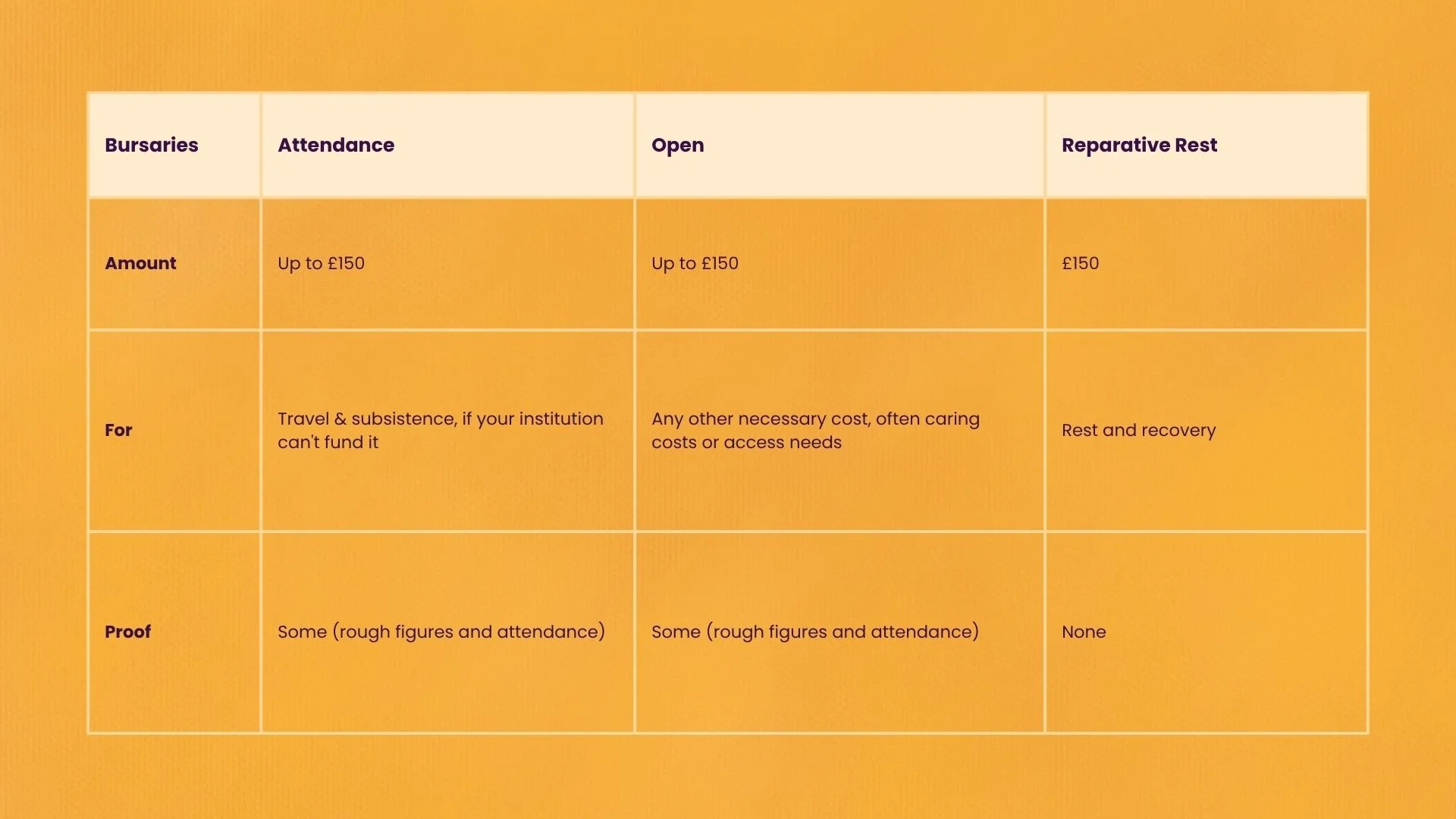
Table showing types of bursaries offered.
What happened next surprised us. We had planned for most money to go to funding the practical cost of getting to events. Instead, reparative rest was the most consistently requested bursary across all four rounds. Of the 88 bursaries we paid out, 46 went to rest, and more than half the money followed it. The main barrier was not necessarily getting into the room - it was recovering from being in it.
Initially we had designed the scheme for being oversubscribed across all bursaries and having to do a randomised selection- as such we have created a robust application form, linking to a set of spreadsheets which can support meticulous record keeping, and a process for the randomised selection and then fund allocation. In reality, we were not oversubscribed and kept a careful eye on how to allocate across the different types of bursaries to meet the needs of the community. As such, our process mostly followed a four-stage process: 1. Announce bursary round + participants apply 2. Review applications + awards bursaries (send and receive bursary details documentation for financial reporting) 3. Pay bursaries + delete banking data 4. Evaluate + adapt the process/approach.
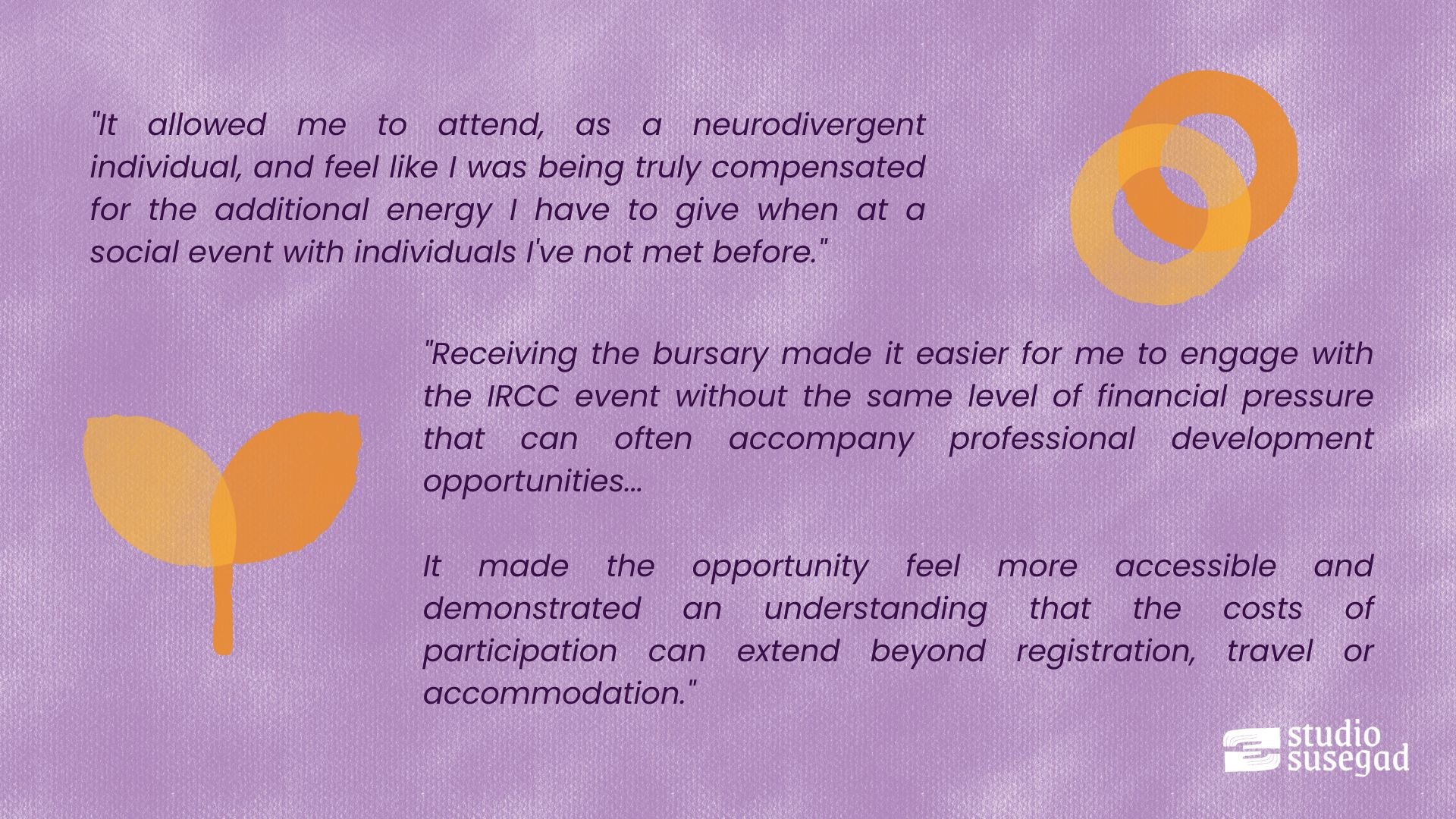
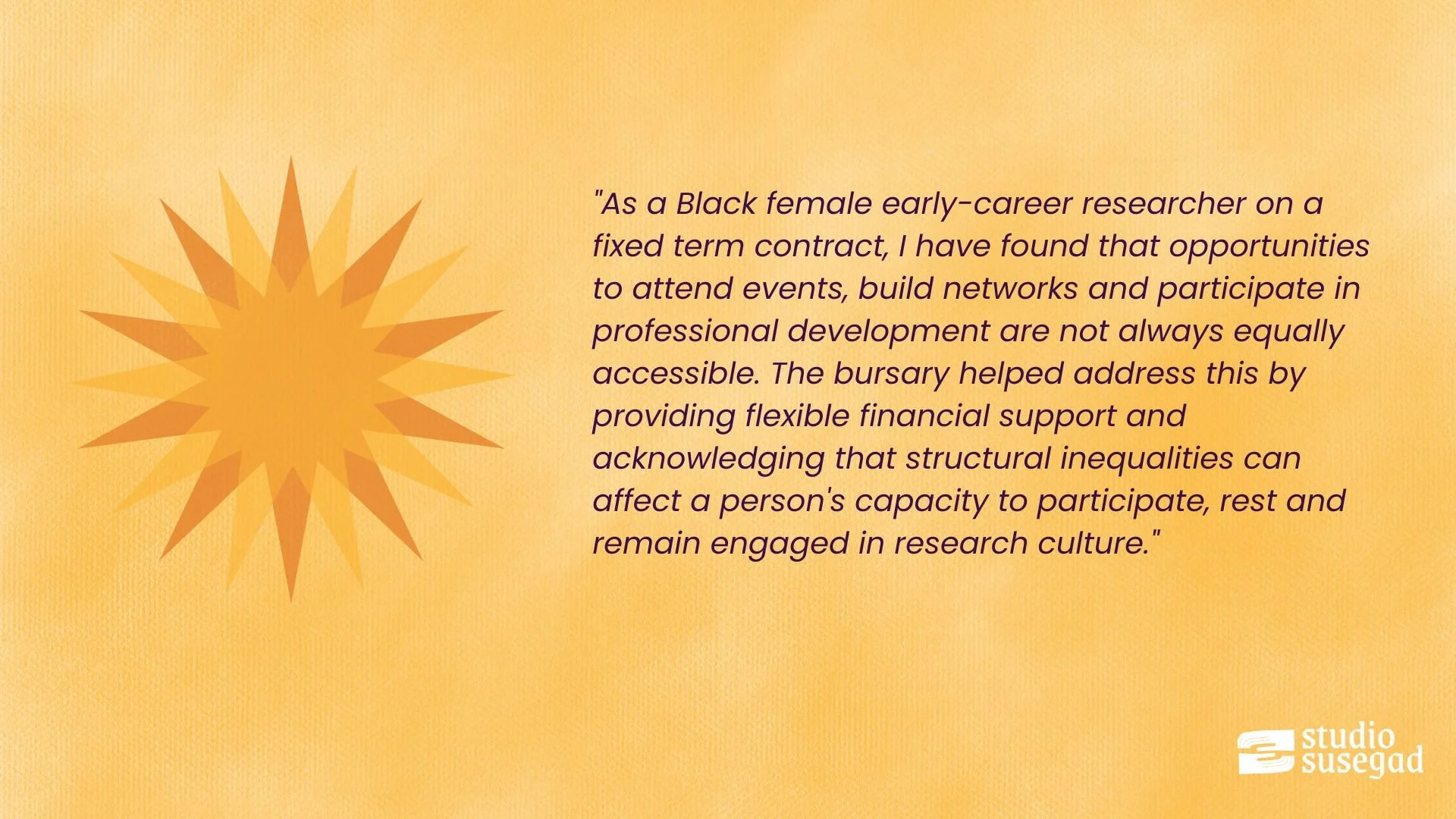
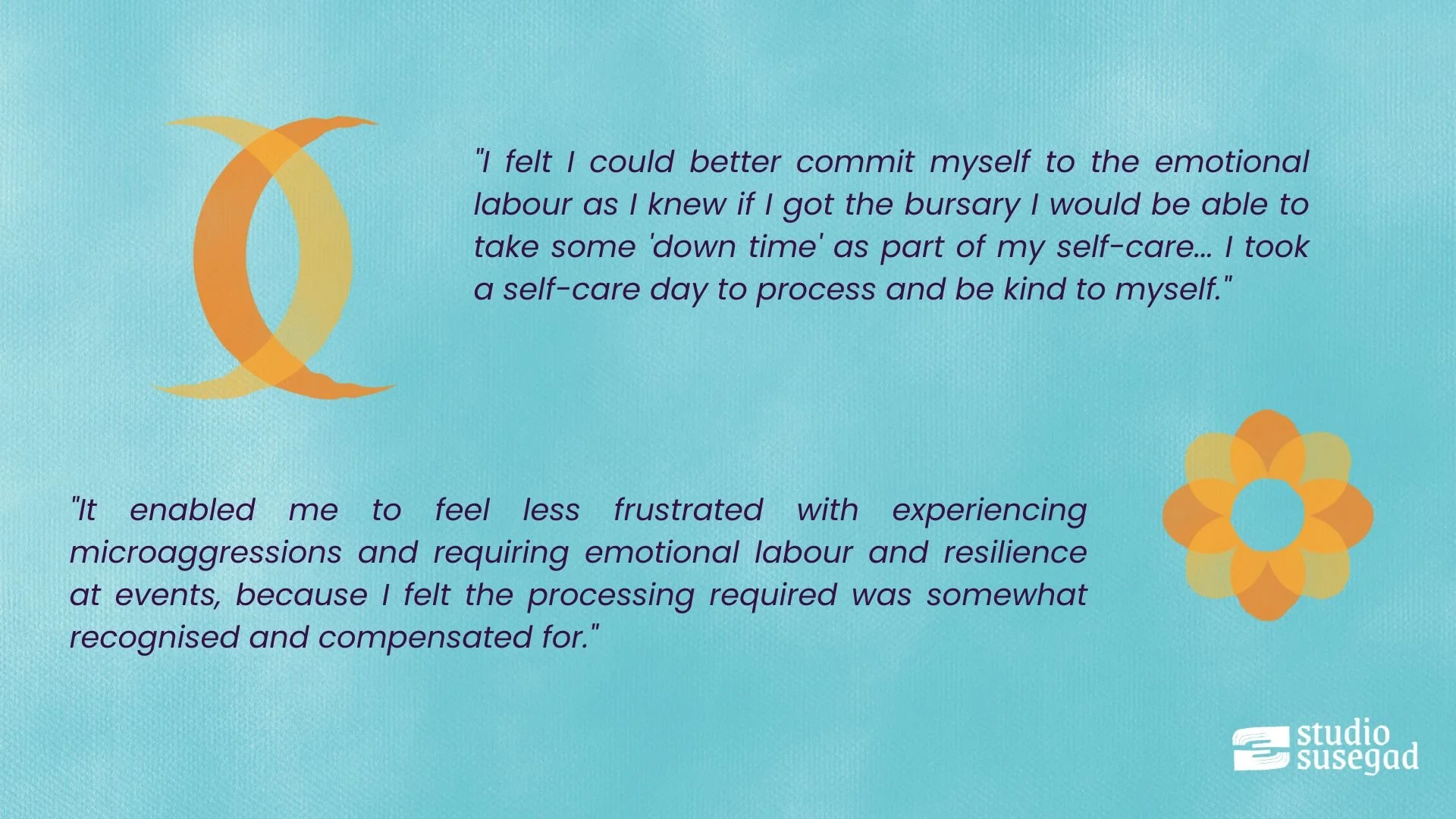
The responses we gathered over email, surveys and in person helped us understand what the bursary was enabling. Some of it was practical - it supported attendance, eased financial pressure, and gave people something to spend on recovery. One respondent told us that proving access needs or disabilities to get support is often so labour-intensive and stressful it puts people off asking at all and the rest bursary was built to remove that barrier as much as possible. Another said it made them "feel safer and more comfortable... as it named barriers to participation." A third reflected that it "communicated that rest and wellbeing are important and should not be treated as something researchers must earn or manage entirely on their own." This acknowledgment mattered as much as the money.
We were honest with ourselves and community members about the limits, too. One respondent described the bursary as feeling "more like a coping mechanism for a broken system rather than a solution." The bursary doesn't fix anything structural on its own - it resources people within the structure that exists whilst showing that there are small ways we might shift the dial on how we meaningfully resource people and projects.
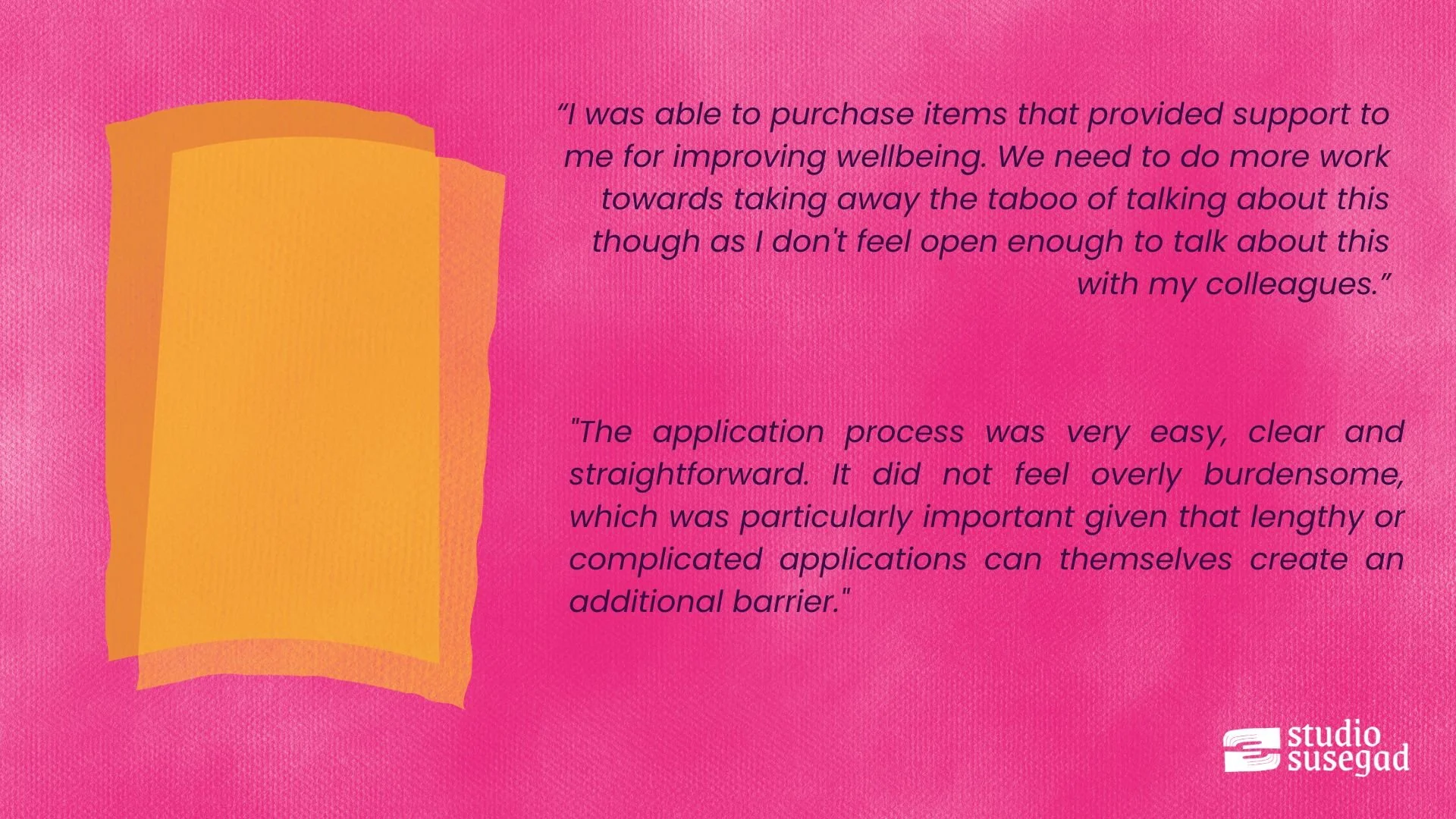
Over two years and four rounds, we settled on principles we'd carry into any future iteration. We built the application into the event RSVP form - every extra step is a reason not to bother or self select out. We trusted people to self-identify with no proof of need, and that trust was consistently honoured. We kept the money flexible and didn't prescribe what it could be spent on, because people know better than we do what rest looks like for them. We paid attendance bursaries in advance where we could, and rest bursaries as close to the event as possible. Bursaries went directly to individuals, because the relationship needed to sit between us and the person, not their employer. And we adapted as we went: reallocating underspent funds towards rest, accepting late applications, reminding people at the events themselves that this was on offer and for them.
It isn't a perfect model. The opt-in design has limits - the people most eligible for a rest bursary are sometimes the least likely to apply for one, and more than one respondent named that tension directly. We mitigated where we could by developing proactive relational approaches along side the open call. We also encouraged and witnessed colleagues sign posting the opportunity to each other, recommending and making space for each other as part of the process: “I would like to apply too, but not if it takes it away from my colleague who I want you to prioritise”.
This ‘building as we go’ was always part of the point. We do iterative and prefigurative work - modelling something different so it stops feeling hypothetical and starts feeling possible: if we don’t try, what will change? At least two institutions within the IRCC began exploring how to adapt the scheme while the pilot was still running, including how annual leave buy-in schemes might build rest days into researchers' contracts directly. That's what we were hoping for: not that we could run a bursary scheme, but that seeing it done, at a funder's invitation, inside a mainstream programme, would give other organisations both permission and a place to start.
We want this to become standard practice: a budget line - built in from the start of any programme that brings marginalised people into rooms to do this kind of work. The administration is manageable, the cost is modest, and the impact, as our respondents described it, is meaningful.
We're happy to share our process, our application form, and anything we learned. Get in touch at hello@studiosusegad.com.
Thank you to Wellcome for backing something untested in their space and for giving us the room to find out what it could do.
Read our final IRCC report Conditions for research culture change: Care, Creativity, Connection, and Composting.